
Last week I gave you this fuzzy little fella to have a go at identifying:
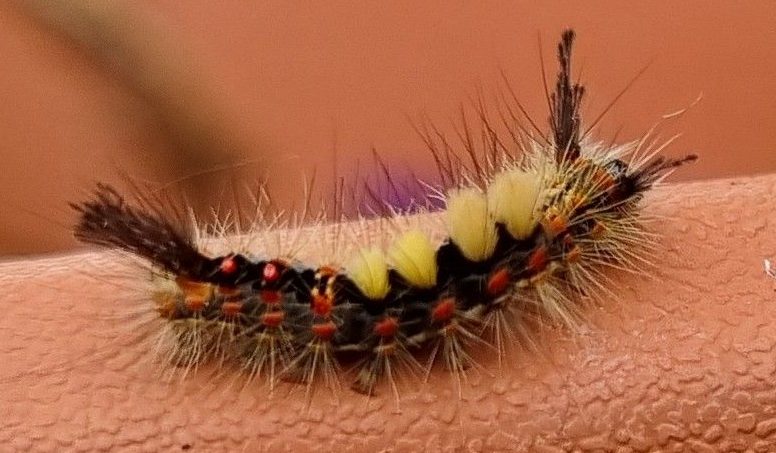
It’s a very distinctive caterpillar and I had a feeling it wouldn’t prove much of a challenge (correctly it turns it). Those tufts of hair, “horns” and bristles are a dead give-away.
As everyone who commented recognised, this is the larva of a Vapourer Moth, also known as a Rusty Tussock Moth Orgyia antiqua (Linneaus, 1758).
This day (and night) flying moth is fascinating, as the adults demonstrate quite extreme sexual dimorphism, with the female being almost wingless and the males flying around seeking her out by detecting her “vapours” – the pheromones she secretes that give these moths the name “Vapourer”.

The name Orgyia is apparently meant to derive from the ancient Greek word “órgyia” meaning “outstretched arms” – referencing the front legs of these moths, which splay out in front of them. However, knowing how much taxonomists enjoy a bit of wordplay, I wonder whether the clouds of males attracted to the vapouring females inspired the name for a different reason…
These moths are quite widespread, occurring in Ireland, the UK, across Europe and they are well established in America. They feed on a wide variety of different plants, but generally don’t cause many issues for gardeners as they tend to not be around in very high densities.
This may be a bit surprising, considering the flightless females can carry and lay large numbers of eggs, since they don’t have to worry about maintaining flight weight. But, numbers of moth eggs laid rarely equate to the number of surviving offspring, due to predation and the actions of parasitoid wasps.
I hope you enjoyed working out the identity of this mystery object, and maybe finding out more about a pretty interesting insect.
 Zygoma