This week I have a fossil mystery object for you to have a go at identifying:

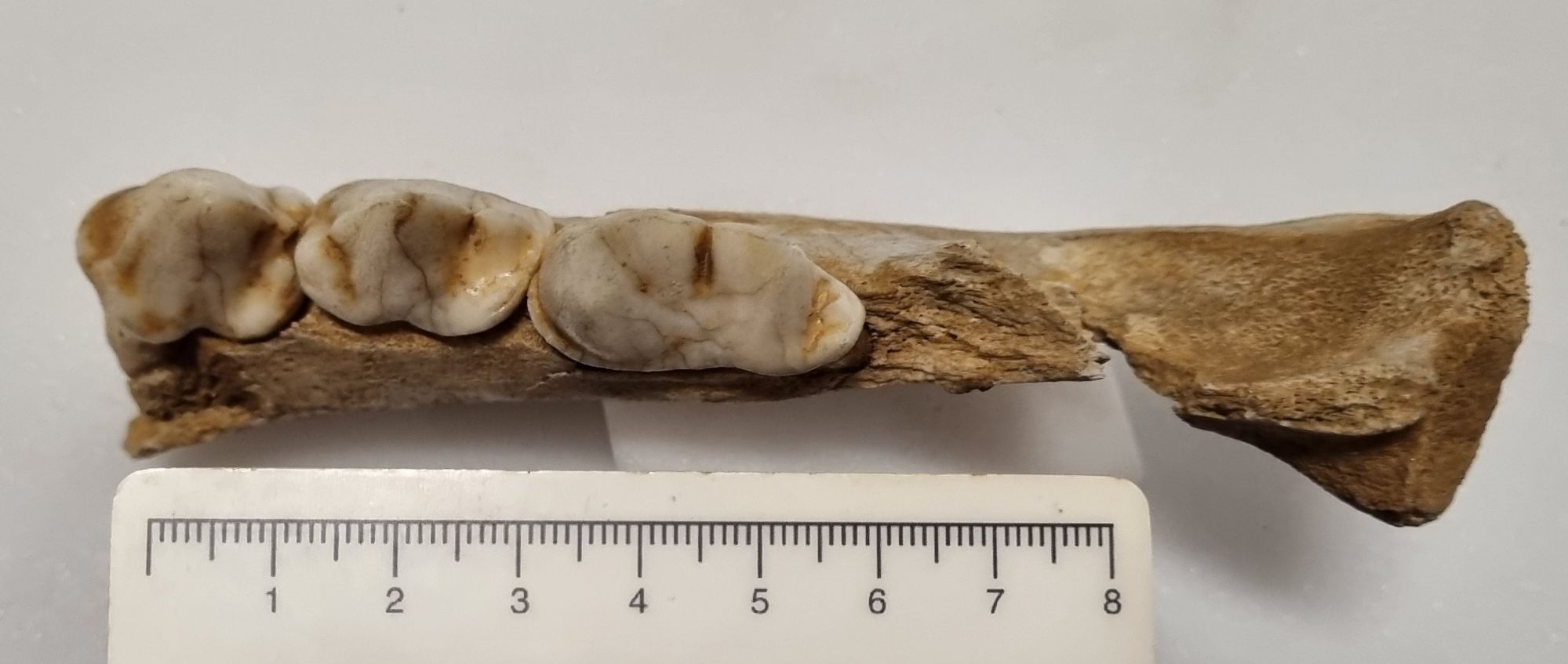
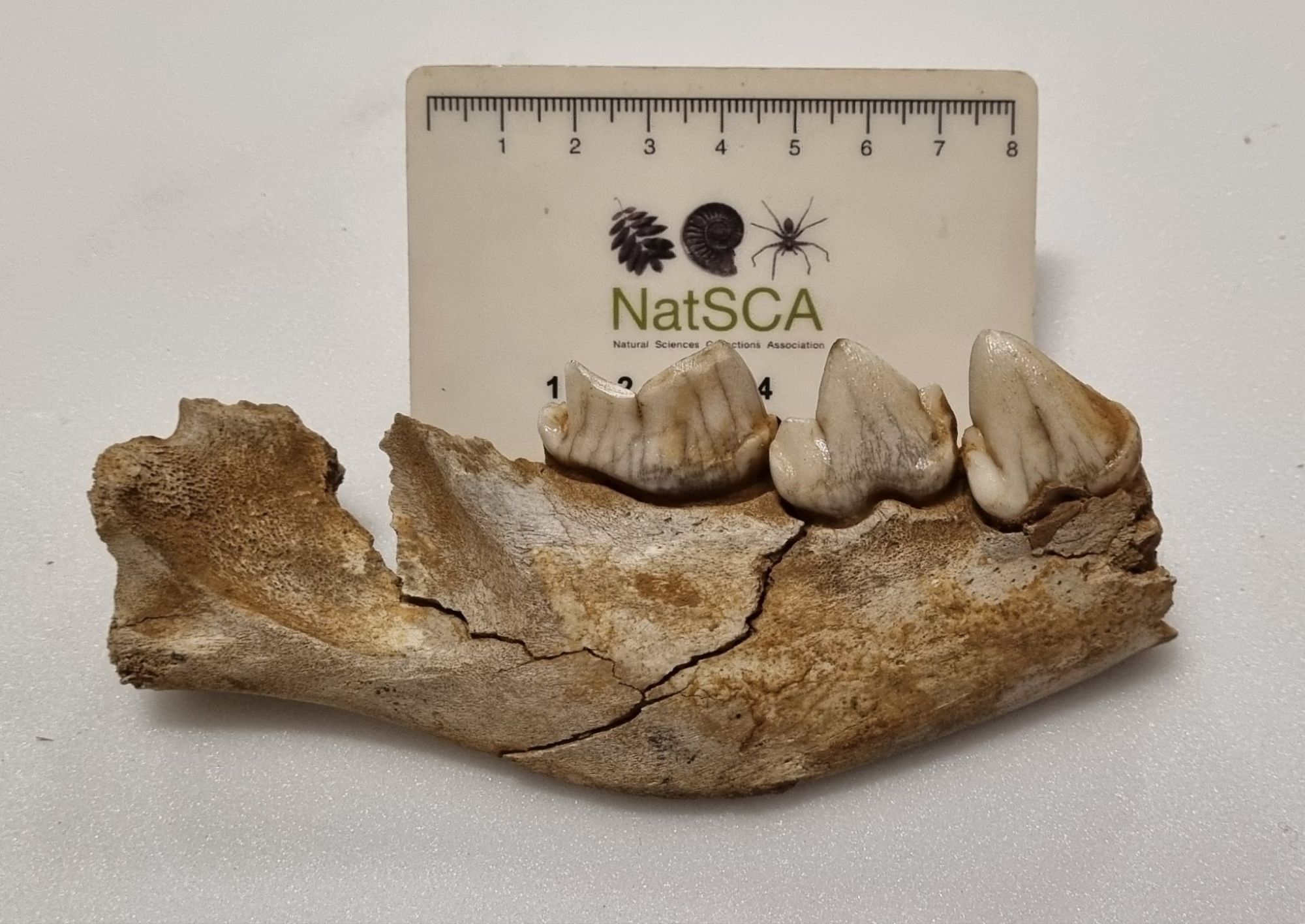
Any idea what this section of mandible might be from?
As ever, you can leave your thoughts, questions and suggestions in the comments box below. Have fun!

This week I have a fossil mystery object for you to have a go at identifying:
Any idea what this section of mandible might be from?
As ever, you can leave your thoughts, questions and suggestions in the comments box below. Have fun!
 Zygoma
A short jaw, carnassial at m1 but no space for much in the way of post-carnassial molars, the teeth look very hypercarnivorous in design – this has to be a member of Sylvester’s family. I’ll have to do some looking to see if I can narrow it down any further.
Crocuta
agreed, i thou’t i’d saw a puddy tat!
comparing to my Leo…. dang this is a big puddy tat.
Other than a carnivore, I have no idea, but I can tell you this: your Friday Mystery Objects bring combat medics a welcome distraction here in Ukraine! Thank you for spreading some knowledge around!
Very happy to provide a distraction – stay safe!
I’ll cave on this one!
Ah, but a cave what 😉
Arrgh! I’ve worked out what it is and now I’m laughing at my earlier ID! No cat has a p3 that big and that shape. There is also a singular feature of these teeth that is a give-away.
😉
OK, so I’m settling on C. c. s. for the subspecies ID.
Parduns me! I don’t think the mandible is thick enough for what you are suggesting Adam…. but…all I can see is Pink.
Have you spotted the markedly curved ventral margin?
ohhhh. Are we thinking marsupial?
No, that’s not where I’m headed. This jaw doesn’t show a trace of an inwardly curved marsupial shelf. I was hinting that the convex lower margin of the jaw in lateral view is most uncatlike
oohhhh! Are we talking pouches?
So, I’m tempted by the same things Adam was initially temted by: has to be a Carnivoran with that carnassial, and the animals on the doggy side of the C. family tree tend to have post-carnassial molars. And, as Joe Vans says, it’s dang big for a puddy tat!
But going with Adam’s later note about the tooth before the carnassial… There are four or so families on the puddy tat-ish side of the family tree, and only one other than Leo and Tigger’s has members this big…
And she species of that family have markedly curved lower edges to their dentaries. So I’m happy with at least the general neighbourhood of Adam’s subsequent thought.
Adam says there is a singular feature of these teeth that gives it away. I don’t know enough to have a sense of what’s singular and what’s not, but… The final premolar has a much bigger “after cusp” than the penultimate one. This probably isn’t unique to this species, but it is at least consistent with C.c. (as is the curved lower margin of the jawbone). As to the subspecific s., the color of the specimen suggests it has been buried for a while: so maybe it is from a spelunkensubspecies.
(Katedemondon. I don’t think carnivorous marsupials tend to have carnassials this shape: certainly the Thylacine doesn’t (didn’t). Or do you have some other candidate in mind I haven’t thought about?
Singular in this context is a pun
Adam–
As in “singular cusps”?
as in “cingula”
Adam – Do you think the last molar was broken off… or?
I thought initially the thickness of the mandible was too narrow for a C.c.
I think the carnassial is the last molar. In other words, like cats, the lower molar row is reduced to just one tooth.
While not the most robust example of the species, I don’t think its proportion is outside the range of variation for the species (admittedly this is just by eyeballing it).
The view from above shows breakage just aft of the molar. So it might have looked a bit more robust originally.
(And thanks for explaining the pun: once you said it was a pun it made sense, the cingulum being a possible location for cusps in postcanines.)