Friday mystery object #58 answer

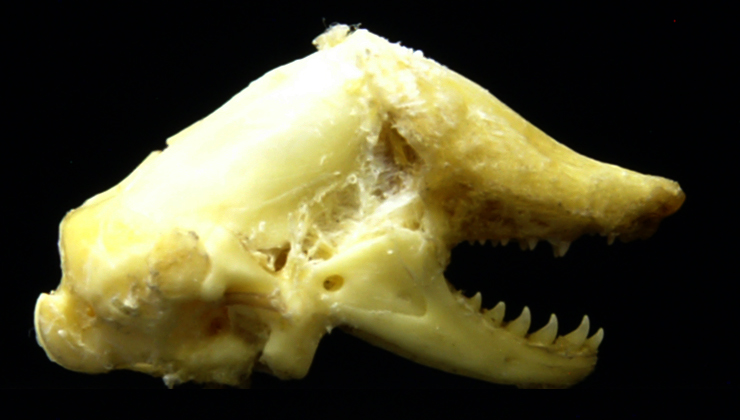
On Friday I gave you this skull as a mystery object, dredged as it was from the memory card of my severely concussed camera:

This was a slightly sneaky object, because I had a feeling that quite a few of you would make the same mistake as I did when I first saw this skull, by assuming that it’s from a large rodent. The large front teeth (the incisors) support this, since enlarged first incisors are a feature of the rodents.

Rodents also have a large gap behind those incisors called a ‘diastema’ – which this skull has for the lower jaw (or mandible), but you may notice that the upper jaw has three incisors in the pre-maxilla (that’s bone in the front bit of the upper jaw) before the diastema. This is easier to see in a side (or lateral) view:

You might notice that there’s a small tooth behind the third incisor in the upper jaw – that’s a canine. You might also notice the faint wiggly line in the bone of the jaw just above the canine – that’s the junction (or suture) between the maxilla and the pre-maxilla bones. The canine is the first tooth in the maxilla and all the incisors are in the pre-maxilla (this is the same for all mammal teeth).

Rodents only have two teeth in the pre-maxilla, not six. They also have no canine teeth in the maxilla. That means this mystery object cannot be a rodent. Here’s what a rodent’s diastema looks like (the suture between maxilla and pre-maxilla is really clear in this photo):

Lagomorphs (rabbits and hares) have teeth similar to rodents, except they have an extra pair of incisors behind the front pair in the maxilla – these are called ‘peg teeth’:

Rabbit_peg-teeth

Peg-teeth in a Rabbit skull

Clearly the mystery object has more incisors than this, plus those canines, so it can’t be a lagomorph either.

So what beastie has six upper and two lower incisors? Several of you worked out that this was a marsupial from the dentition (namely Cromercrox, jonpaulkaiser, David Craven and Zigg), but only Prancing Papio and Jamie Revell managed to get it to species, namely the  Continue reading

Friday mystery object #58

Alas, my camera died after receiving a bit of a knock, so the mystery object I had planned for this week has been replaced by one of the last specimens I took a photo of:

Any idea what this specimen is, where it lives or what it might eat?

Put your suggestions, observations and questions in the comments section below and I’ll do my best to answer as the day goes on. Good luck!

Friday mystery object #57 answer

On Friday I gave you a specimen that I had to identify myself earlier in the week:

The first steps of this identification are quite straight-forward – in the words of Jake it “Looks a bit sheepy and a bit deery” which pins this firmly in the order BovidaeDave Godfrey neatly summarised what makes it look sheepy and deery – “Diastema, lack of upper incisors, and the shape of the teeth“. Rob went a step further and ruled out deer, sheep, goats and camelids – coming to the conclusion that this is an African bovid of some kind. Then David Craven blasted through the narrowing-down process and hit upon the same species as I had concluded it was, namely a  Continue reading

Friday mystery object #57

This Friday I’m taking the mystery object back to its roots, with unidentified specimens that I’ve found in the collections at the Horniman Museum where I am a curator. Yesterday myself and my trusty volunteer Cat came across two boxes labelled NH.83.1, which between them contain twenty unidentified skulls from a variety of different animals, ranging from fish to birds and mammals. This box had been in the collections since the 1930’s and there was little information to help make identifications – perfect material for mystery objects! Here’s one of the specimens I managed to identify – I’d like to see what you come up with…

As usual, put your observations, suggestions and questions in the comments section below and I’ll do my best to give you what information I can. Good luck!

Friday mystery object #56 answer

On Friday I gave you this object to identify:

I must admit that I thought it would be a tricky one, but I was surprised by the number of correct answers that came in, with the first by Prancing Papio who immediately got it to species. Neil made a subtle comment (“Looks like it could go both ways“) that almost passed me by, but which indicated that he knew which group this skull belonged to (see below for elucidation), whilst David Craven and Jamie Revell both pinned it down to species as well. That identification was  Continue reading

Friday mystery object #55 answer

On Friday I presented you with this anthropological mystery object:

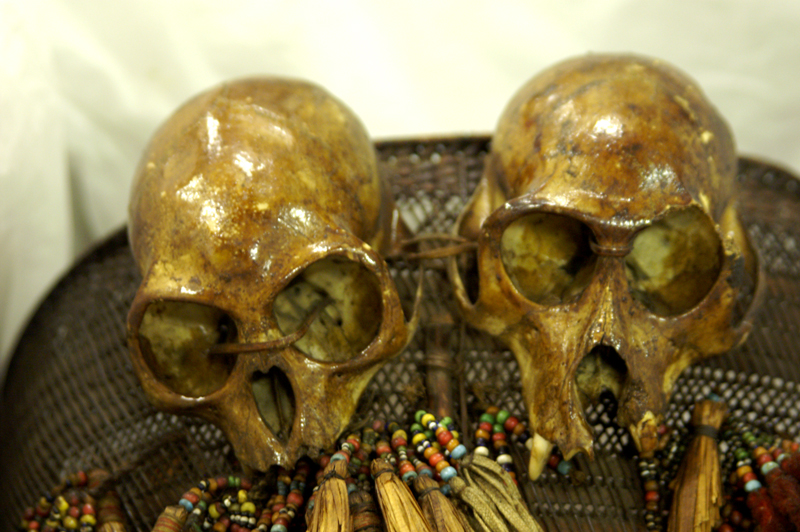
I wanted to know what it is, what it’s used for and where/what culture it’s from. Since there are skulls on it I thought it would be a good idea to ask you to identify them while you were at it. No small task then.

Alistair was first to notice that the skulls belonged to monkeys, then Smallcasserole made the comment:

It’s the Predator’s earthly trophy bag with human skulls!

Which although not entirely accurate, is correct in identifying what this object is used for – it’s for carrying trophies. Moreover it’s for carrying the same trophies that the Predator might be out collecting…

Jonquil and Dave Godfrey worked out that it’s a basket rather than a bag and then Jonquil came through with a tribe in the right culture and place. I can’t be sure of the particular tribe this is from, but the culture is that of the Naga from the Northeastern part of India (Assam in this instance), who were renowned for the practise of head-hunting (and I don’t mean in the recruitment sense) until quite recently.

As to the monkey skulls, jonpaulkaiser suggested one may be from a Macaque and Jonquil suggested Gray Langur, while Dave Godfrey suggested Macaque and Gibbon. David Craven then provided a remarkably coherent and accurate answer:

Looks like a head-hunting bag, as used by the Naga (I couldn’t give a specific tribe). Still a very fraught part of the world unfortunately.

So, what sorts of monkeys do we have in that part of India?
Loads of Macaques, but others have said Macaque without being censored. Unless that’s too general to be censored…

Okay.
I’ll say Capped Langur on the left (I also considered Hoolock Gibbon).
Macaque on the right? Hard to find good images of macaque skulls for some reason, so I have to shoot in the dark a little. Stump-tailed Macaque.

I think this is about as good an answer as I could hope for, partly because it reflects the levels of uncertainty that we are often stuck with in the museum world. The basket/bag came from Assam and it entered the collections around 1903 judging by its label. There was no tribe name associated, so that information would prove difficult (if not impossible) to track down. The primate skulls are damaged and they are attached to the bag, making them difficult to inspect in the kind of detail needed to make a certain identification.

I was personally leaning towards the skull on the left being that of a Hoolock Gibbon Hoolock hoolock (Harlan, 1834) based on the distance between the eyes, but I’m not convinced that this is reliable and the shape of the nasal opening (long and heart-shaped) doesn’t quite fit with this idea. It could indeed be a female Capped Langur Trachypithecus pileatus (Blythe, 1843) but probably not a Gray Langur Semnopithecus sp. Desmarest, 1822 because their range doesn’t quite fit. It could even be a female Macaque of some sort (although the width between the eyes looks too big for that).

The skull on the right looks like a male Macaque, probably a Rhesus Macaque Macaca mulatta (Zimmermann, 1780) or a Stump-tailed Macaque Macaca arctoides (I. Geoffroy, 1831) – with my preference being the more common and widely distributed Rhesus (compare 1 & 2). I am keen to see David Craven’s reasoning, to see what I may have missed.

Many thanks to everyone for their comments and suggestions. I particularly liked the idea by cackhandedkate that the basket was one of Lady Gaga’s costumes – something that I would not be surprised by.

Friday mystery object #55

For this week’s mystery object I am going to try something for everyone – a bit of Anthropology with some Natural History thrown in. So what is this, what’s it used for and where/what culture is it from – your bonus question is of course what species did the attached skulls belong to:

As usual questions, suggestions and observations in the comments section below, I’ll do my best to answer as the day goes on. Good luck!

Friday mystery object #54 answer

On Friday I gave you this skull to identify:

I was impressed by the efficiency with which the possibilities were whittled down and the correct species identified, since this isn’t an animal that’s very well known by most people (in the UK at least). Dave Godfrey immediately recognised this as being a member of the Carnivora and a dog-like one at that, an opinion supported by Matthew Partridge’s observations.

This line of investigation was somewhat derailed by Gimpy’s suggestion that this was a Tasmanian devil skull, an observation that was incorrect, yet very pertinent, since there are quite striking similarities between this and a Tasmanian devil skull as a result of convergent evolution. It’s strange to think that two species can look so similar and yet be separated by at least 124 million years of divergence (check out the placental-marsupial divergence node using the awesome University of Bristol Date-a-Clade webpage). That’s what similarities in environment and lifestyle will do to organisms with similar ancestral skeletal bodyplans.

Debi Linton then came to the rescue with some astute observations about the teeth of this animal and after trawling the Skulls Unlimited site (which appears to be much-used by people hunting for the answer to the FMO) she hit upon the correct answer of Continue reading